Sometimes You're Not Stuck on the Decision — You're Stuck on the How
When You Already Know What You Want, but You’re Still Stuck
We often think we’re stuck deciding between two options. But if we're honest, the real issue usually isn't the decision at all. It's figuring out the "how." We already know what we want. We just don't know how to make it happen.
So instead of recognizing that what’s really going on is that we feel overwhelmed, under-resourced, scared, or unsure where we’d find the time, our brain gets fixated on the surface-level decision:
“Should I quit my job and pursue my dream, or stay where I am?”
“Should I go after my MBA even though I barely have time to breathe?”
“Should I get my broker’s license to grow my business, or just stay where I’m at?”
But the reality is, the tension isn’t actually between Option A and Option B. It’s between what we want and what feels realistically possible.
And honestly, that’s a much harder thing to name.
Why "I Can't Decide" Is Usually Fear in Disguise
It’s easier to say, “I just can’t decide,” than it is to say, “I’m terrified this won’t work out.”
Sometimes we’re afraid of failing. Sometimes we’re afraid of wasting time or money. Sometimes we’re afraid people will think we’re irresponsible for taking a risk, or that they’ll quietly judge us if things don’t pan out the way we hoped. And sometimes we genuinely have no clue how we’d make the logistics work, so our brain treats the entire dream like it must not be the right decision after all.
But not knowing how doesn’t automatically mean you’re on the wrong path.
A lot of people stay stuck because they think the problem is deciding whether they want the thing, when really the problem is that they haven’t figured out the roadmap yet.
When You Feel Trapped Between What You Want and What Feels Possible
I see this a lot with business owners who are debating whether to shut down their business and go back to a corporate job. They keep calling that “the decision,” but deep down, not a single fiber in their being actually wants to go back to the 9–5.
What’s really happening is that they feel like they’ve exhausted all their options.
They’ve tried the ideas they know to try. They’ve brainstormed. They’ve watched the videos. They’ve tested things. Nothing seems to be working, and every new idea either feels too risky, too expensive, too unrealistic, or too far-fetched to actually work.
So they stay stuck in this exhausting tension between knowing what they want and not knowing how to get there.
That’s the line I really want you to sit with, because I think so many people live there for years.
Sometimes you are not actually stuck between two options. You’re stuck between a dream and the missing roadmap to get there.
And those are two completely different problems to solve.
So, What's the difference between being stuck on a decision vs. stuck on the how?
Being stuck on a decision usually means you're genuinely weighing two options that feel equal — you can see yourself going either direction, and you truly aren't sure which one is right.
But being stuck on the "how" looks different. You already know what you want. Deep down, one option is calling you louder than the other. The problem isn't the choice itself — it's that you can't see a clear path to get there yet. And when the path feels invisible, our brain tricks us into thinking the dream must not be the right one. It's not indecision. It's a missing roadmap.
What should I do if I know what I want but don't know how to make it happen?
Start by separating the goal from the logistics — because they're two completely different problems that need two completely different solutions. The logistics are how you’ll achieve your goal — but they’re still different from the decision itself.
Once you stop treating "I don't know how" as a sign you're on the wrong path, your brain has room to actually start problem-solving. Ask yourself what would need to be true for this to work, even imperfectly. What could shift, simplify, or change temporarily to create space for this? You don't need the full roadmap on day one. You just need to stop confusing the missing map with the wrong destination.
Tunnel Vision Makes Us Think We’ve Exhausted Every Option
One thing I’ve noticed is that overwhelm tends to create tunnel vision. We convince ourselves we’ve exhausted all possible solutions, when really we’ve only exhausted the solutions we can currently see from our limited perspective.
That doesn’t mean the answer is easy. It also doesn’t mean every dream is supposed to happen exactly the way we pictured it. But sometimes the solution is less about abandoning the goal and more about getting creative with the approach.
Maybe the answer is changing the timeline or simplifying another area of life temporarily. Maybe it’s restructuring your offer, targeting a different niche, or approaching the same problem from a completely different angle. Sometimes the answer is simply getting outside your own head long enough to see possibilities you couldn’t see before.
Don’t Try to Pivot Everything at Once
Now, I will say this too. If you try to reinvent your entire life, business, schedule, marketing strategy, and personal habits all at the same time, you’re probably going to overwhelm yourself even more.
When people panic, they often start throwing spaghetti at the wall in ten different directions at once. Then they don’t know what’s working, what’s not, or where to even focus anymore.
Instead, ask yourself this:
What’s the most important thing I want to stay the same?
That question alone can narrow things down so much.
Once you know what matters most, you can start identifying where there’s actually room to pivot.
Real-Life Example of Solving the “How”
Take the busy mom who wants to pursue her broker’s license because she knows it would help grow her real estate business long-term. On paper, she feels stuck trying to decide whether she should pursue it or not, but maybe the real issue is that she cannot currently picture how it fits into her already-maxed-out life.
That’s a completely different conversation.
Maybe she temporarily takes one less client each month while she studies. Yes, it’s a short-term sacrifice financially, but long-term it could increase what she makes per transaction and create more freedom later.
Or maybe she stops putting pressure on herself to cook every meal from scratch for a season. Maybe she simplifies dinners, uses grocery delivery, or swaps childcare with another work-from-home mom a couple afternoons each week.
Once she stops obsessing over whether she’s “supposed” to pursue the dream and starts brainstorming ways to support the dream, her brain finally has room to problem-solve creatively.
And honestly, that shift changes everything.
Sometimes You Don’t Need a New Dream — Just a New Angle
I think a lot of people quit too early, not because the dream was wrong, but because they ran out of visible options.
Sometimes the business doesn’t need to die. Sometimes the offer just needs to change.
Sometimes the answer is a different niche, a different schedule, a different audience, a simpler business model, or a more focused strategy. Sometimes you don’t need to burn everything down and start over. You just need a fresh perspective from someone who isn’t emotionally trapped inside the problem with you.
That’s why brainstorming matters so much more than people realize.
Because when we’re stressed, overwhelmed, emotionally attached, or scared of failing, it becomes really difficult to think creatively. We cycle through the same thoughts over and over again and convince ourselves we’ve tried everything, when in reality we’ve only tried everything we personally thought of.
Feeling Stuck Between What You Want and How to Get There? Start Here.
I've lived this tension myself. A year into running my graphic design business full time, I was burning out — working far too many hours for far too little pay. On the surface, the decision looked like: do I keep going or go back to a 9-to-5? But that wasn't really the question. The real question was: how do I keep this business alive? Because the entrepreneur in me wasn't ready to give up... not without a fair fight.
So I took to what I do best — problem solving, brainstorming, and reverse engineering.
I spent an entire weekend using my sliding glass doors as whiteboards, mapping out every possible path forward. Passive income. Hiring a marketing team. Bringing on a junior designer. Picking up a side hustle. I dug into my strengths, weaknesses, personality, goals, and the kind of life I actually wanted to build.
And through that process, I was able to uncover the path that fit me best — one that allowed my entrepreneurial journey to continue in a healthier, more sustainable way.
And now, I’ve bottled that process up for you — so you can uncover how to make your dreams happen, rather than settling simply because you can’t yet see the path forward.
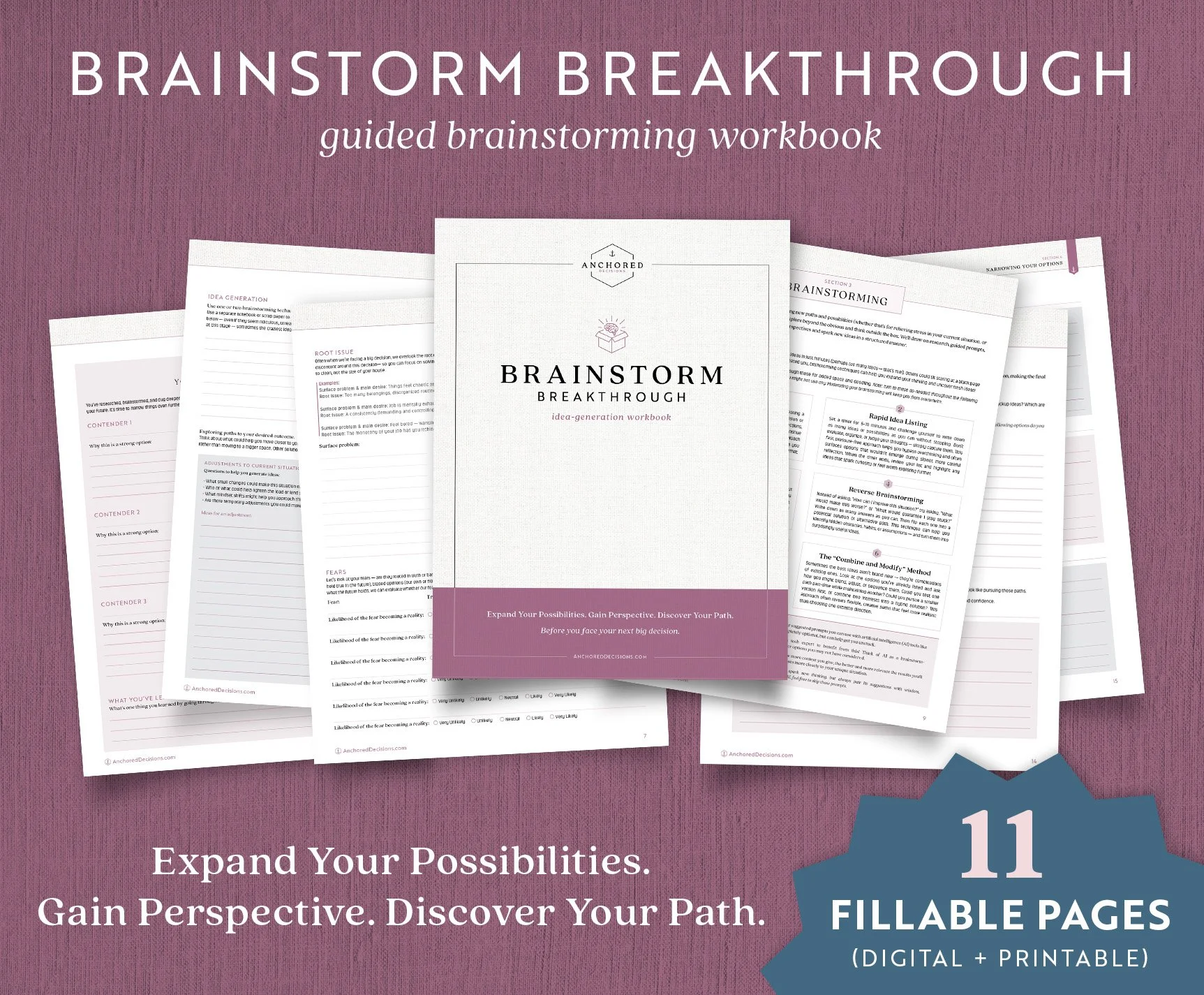
The Brainstorm Breakthrough Workbook was designed to help you think outside the box, uncover fresh possibilities, work through roadblocks, and brainstorm creative solutions you may not have considered yet when you feel stuck between what you want and how to make it happen.
Because sometimes the answer isn’t giving up on the dream. Sometimes you just need help finding a different route to get there.